Showing posts with label trips. Show all posts

Sunday, July 8, 2012

Florida Caverns State Park

Today we went to visit the Florida Cavern State Park.  It is home to one of the only "tour caves" in the Florida.  To be honest, after being at Carlsbad, I was not expecting much.  Perhaps a small cave with one or two formation.  I was pleasantly surprised at what I got though.  The tour lasted ~45 minutes more or less, and we went through at least 6 "rooms".  In each was a wide array of formations, all the ones I love...  Columns, draperies, soda straws, etc. 

The waterfall room

Some draperies in the entrance room

The caves themselves were full of interesting reminders of Florida's geological history.  The ceilings in most of the rooms boosted tons of fossils; mostly clam shells, but our guide pointed out a shark tooth and a nautiliod shell.

Sea urchin test and clam shell on the cave ceilings

We also were lucky enough to see some cave life, including a bat.  After the cave tour there was still plenty to see, so we went off on one of the most recommended hikes, the flood plain/ tunnel trail.  It was interesting to see the different habitats in the area.  Just outside the cave exit, the cool cave air allowed for these liverworts and mosses the thrive.

A snail active at noon, made possible by cool air blowing out of the cave

There were pockets of limestone and mini cave openings everywhere, but the flatter parts (the flood plains) had all the hallmarks of a cypress swamp.  There were columbine plants everywhere, and I made a resolution to come back in the spring to see all the wildflowers blooming.  From the pictures in the visitor center, it looks amazing!

On the bluffs, it's all hardwood forest

There was also a lot of wildlife.   Being Florida, a lot of it was bugs.  We saw beetles, golden orb weaver spiders, golden silk spider (BIG), spiny orb weavers, and a new one for me, harvestman.  As a matter of fact, when I stopped to take a picture of a beetle, a cool-looking true bug landed on me.  There were tons of butterflies near the flower field in front of the visitor center.  I counted at least four different species in five minutes.

Harvestman

There was also some reptiles out and about, including a bunch of five-lined skink young.  There were a couple of adults out as well, but they aren't as colorful.

This little one caught a bug

All and all a must see stop in the North Florida region... Like most state parks, getting in is fairly reasonable, $5.00 for a car of up to 8.  The cave tour itself costs extra, but at $8.00 for an adult, it is still pretty modest.  I will be going back again, for sure!

Saturday, October 22, 2011

St. Marks Wildlife Preserve


Today I went to St. Marks for their Monarch butterfly festival. They were tagging butterflies that use the preserve as a stop over for their migration to Mexico.


There were quite s few pollinators out... Like this Gulf Fritillary and bee friend.

And Buckeye butterfly...

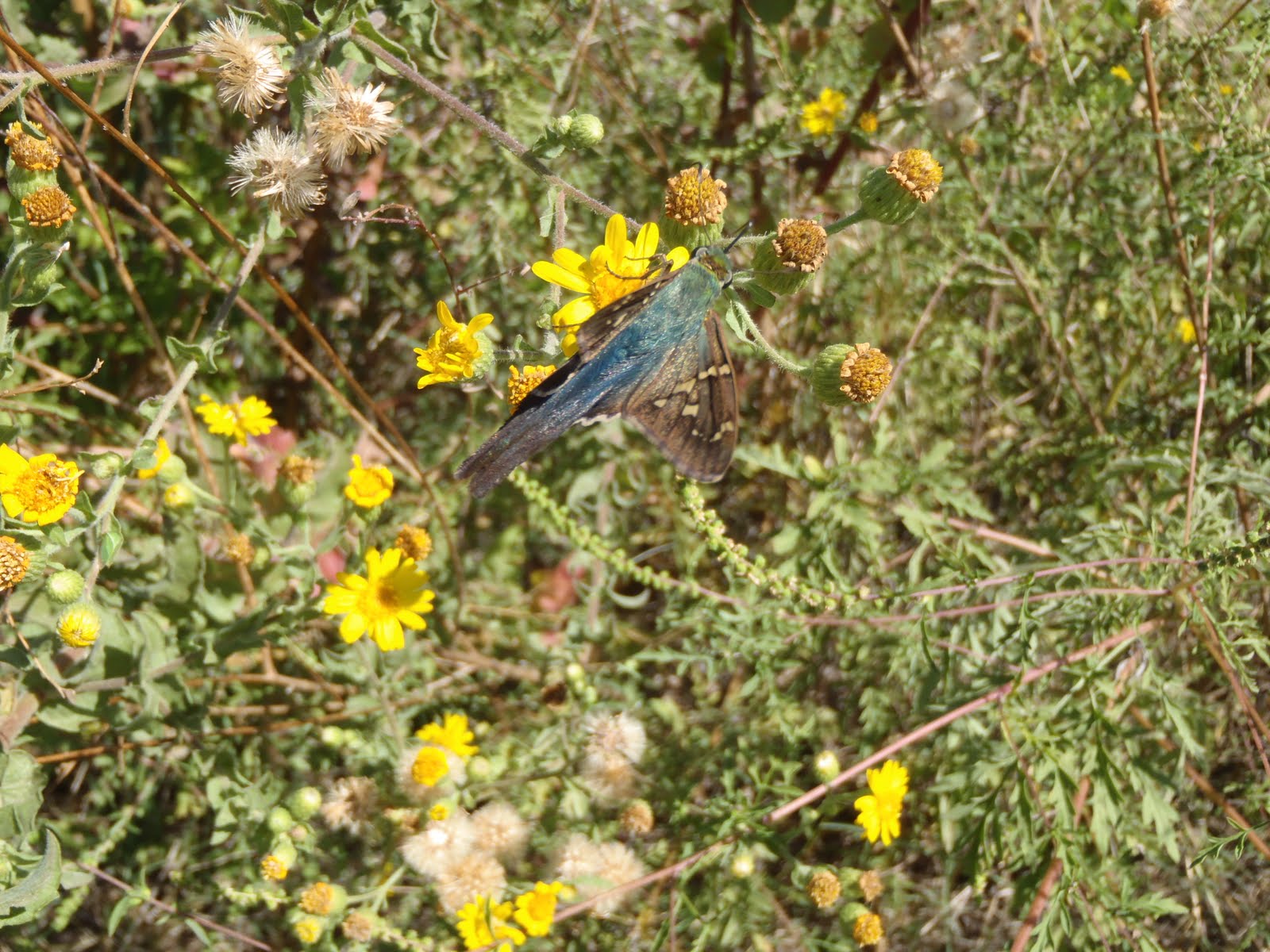
I was fascinated by this plain-looking butterfly called a long-tailed skipper. It looks pretty dull from the side...

But the back are beautiful and delicate shades of blue and green

There were also plenty of birds about... like this mocking bird.

And crazy-looking caterpillars. If you look closely, it's back end has a false head for the birds to eat.

All around was nature in action... like these dragonflies mating.


And this mantis taking advantage of the bounty of butterflies!

All and all a great place to go if you are into birds, bugs, or flowers... I will definitely return. To see what's new and maybe get a glimpse of the illusive spoonbill!

Sunday, September 11, 2011

Leon Sinks State Park

Today I went to Leon Sinks State Park. It is part of a larger park, but is an area where there are some sink holes. Basically the entire area is made of limestone and there is an extensive aquifer under the ground. As rain water and the ground water eat away at the limestone, sink holes form. Some of the "sink holes" were fairly unimpressive, as they were just places where the ground was lower than the surrounding area, but a few were very sharp. The most impressive was the big dismal, which had a sharp drop of 100 feet, to water which was also 100 feet deep.

There was also some swamps in the area. But unlike the wet sinks, they were mostly dry. The forest itself was dry and a lot of the foliage was turning brown. However, we still got glimpses of some beautiful flowers hidden here and there.

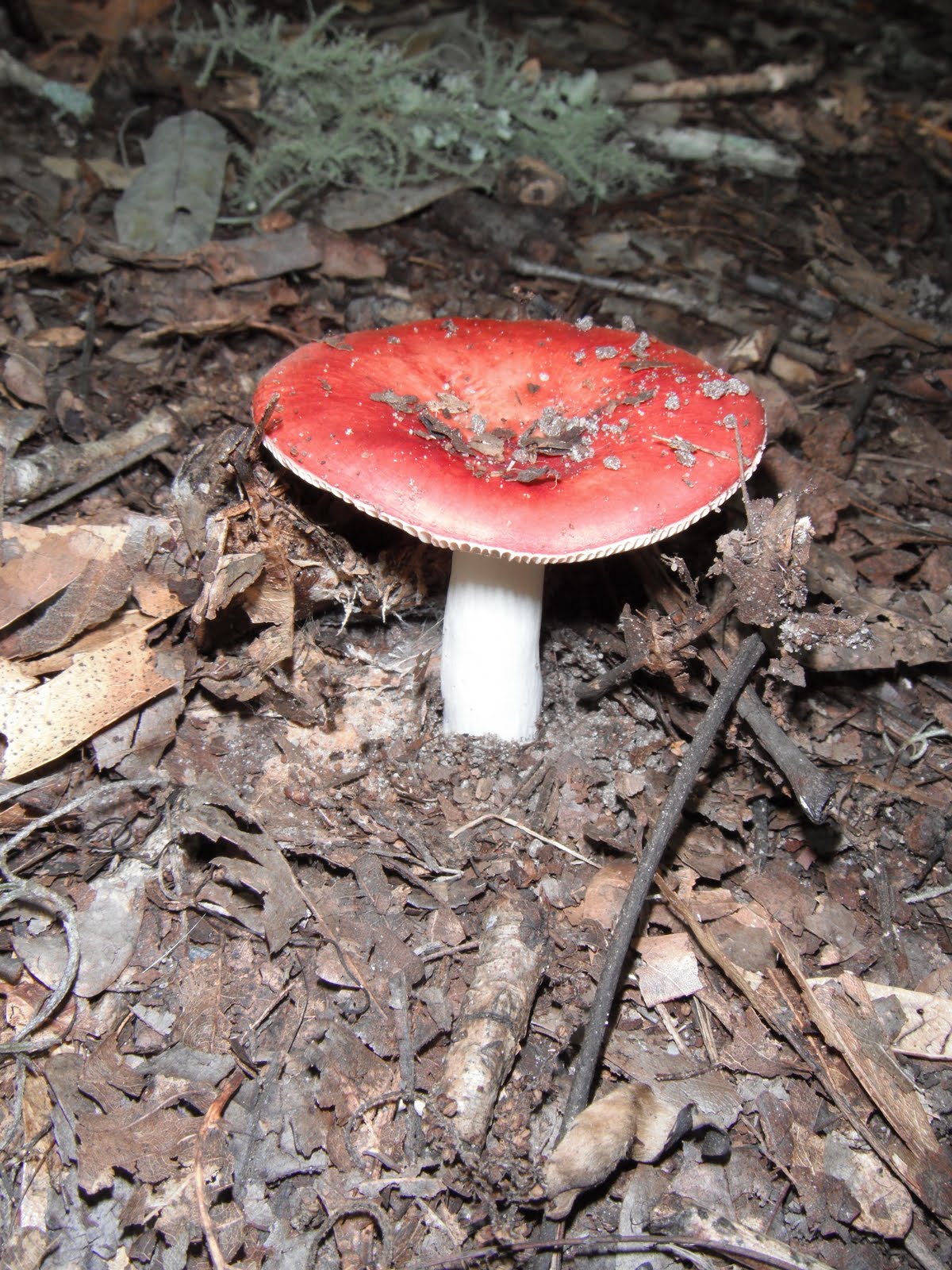
There were also a surprising number of mushrooms about especially given how dry it was. This one looked awesome, it may be a Russula pulchra.

There was also this crazy-looking batch of mushrooms which I am fairly sure are earthstars, or some other puffball type mushrooms. These explode spores out through the top of their body when they get ripe enough. The white ones are unexploded, and the brown one has already released its spores. Probably the best thing that I saw in the park!

Of course what I've learned about Florida is that it is all bugs, and things that eat bugs. We saw our fair share of dragonflies, bees, gnats, and a lot of grasshoppers. We also saw this Golden Orb Weaver, which I had originally seen in the LA Natural History Museum's spider pavilion. It was definitely something to see it in the wild! I though it was from some far away country like Malaysia.

We also saw these awesome beetles. They were quite large, about the size of my thumb, or a little smaller.

The biggest find of the day was this beautiful five lined skink. We saw it near the big dismal sink, where it was hanging out inside the tree.

Of course, I nearly had a heart attack when a big group of people stomped by and scared it away before I could get a picture... But a little patience and it came back again and I got the shot!

Saturday, August 20, 2011

Snorkeling in a hard-bottom gulf community...

Snorkeling in the gulf in a rocky bottom area brought some new animals and some old... The beach itself was more peopled and it was mostly a sandy bottom habitat with a man-made break wall. It was that break wall that was the object of my snorkeling activities.

There were many more types of fish in the rock areas than in the sandy-bottom area that I had previously visited. The rocks provided an excellent surface for algae to grow. Which in turn, provided excellent foraging opportunities for many fish, like these sergeant major fish.


There were also some predatory fish, like the mini-barracuda which I spotted, but did not get a good photo of, and this large sheephead (not to be confused with the California sheephead) with its attendant remora.


There were also some fish that were present in both spots, like flatfish and this toadfish. Although I did not see the toadfish in the sandy-bottom area, I knew it must have been present because I could hear it. It drove me nuts trying to pinpoint the noise coming from this fish. It was so loud that if I was swimming over it, I could feel it vibrate through my body.

There were also many invertebrates, most noticeably crabs. But unlike the sandy-bottom habitat, most of these crabs did not decorate themselves, nor did they bury themselves in the sand. Instead they hid in rocky crevices. You can also see some of the large colonies of compound tunicates in this shot...

There were some snails, which were laying eggs on the rocks...

and some blennies that were living in the holes of the rocks.

Of course there were also some soft corals at the base of the rocks, many compound tunicates, and urchins... But my favorite find of the day was these beautiful jellyfish.


They had a very mild sting, but I did not know that at the time so I kept my distance. If I had known, I probably would have gotten closer. At times, some individuals played host to fish, and I found out that there may have been crabs living in their bell as well.

My final critter of the day was this octopus, which was caught by a fisherman on the break wall. He let it go and I was able to grab this shot before it scuttled off.

Pretty neat, and definitely a higher diversity of fish than in the sandy-bottom area. I can't wait to compare it to a more natural hard-bottom habitat, such as a coral reef habitat!

Wednesday, August 17, 2011

Snorkeling in the gulf...


I went snorkeling a few days ago, in a nice sandy-bottom habitat. Unlike the west coast, the gulf sandy-bottoms are very shallow for a long way out... and warm!

I saw some large sand dollars, a ton of snail tracks, and worm castings. All evidence of a thriving infaunal community.


There were even many egg masses, like this, poking up from the sand.


Most of the life was focused in and around patches of sea grass. It was here you had a lot of the megafauna, like this blue crab, hanging out.


I also saw this puffer fish, and a couple of stingrays...


Of course, I did not really see the stingrays until they moved and swam away from me!


There was a lot of crazy interactions happening all around me too. Like these snails... I don't quite know what's going on here, but I think the one snail is being eaten by the other!


And of course, the obligatory battle between fiddler crabs on land...


All and all a good time... and surprising too. While I expected to see the stingrays, sanddollars, worms, and snails. I did not expect to see urchins, tunicates, and mussels which generally prefer harder, rocky substrates. Many of them were nestled in the sea grass. Perhaps the mussels had settled in the root system of the sea grass, and the tunicates settled on them.


I can't wait to see what a rocky-bottom habitat holds in store!

Sunday, June 12, 2011

Catalina Above and Below

So I went on a trip to sample some of the sea life found around Catalina Island this past weekend. In the deeper parts we found some hag fish, which produce copious amounts of slime with the slightest provocation. The slime has microfibers in it and makes it particularly strong.

We were also lucky enough to get a deep sea octopus. This one might be a big-eye octopus, as it lacks the spots of a two-spot octo, and was caught in very deep water.

This trip was filled with all sorts of cool mollusks, like this very large black sea hare. It was probably around 13 pounds. We caught about three of these beauties. The black sea hare is the largest gastropod in the world! Luckily for me, it does not ink.

We also got a lovely navanax. The navanax is a predatory snail that follows the slime trails of other snails then swallows them whole. After digesting them, it will spit out the cleaned out shell.

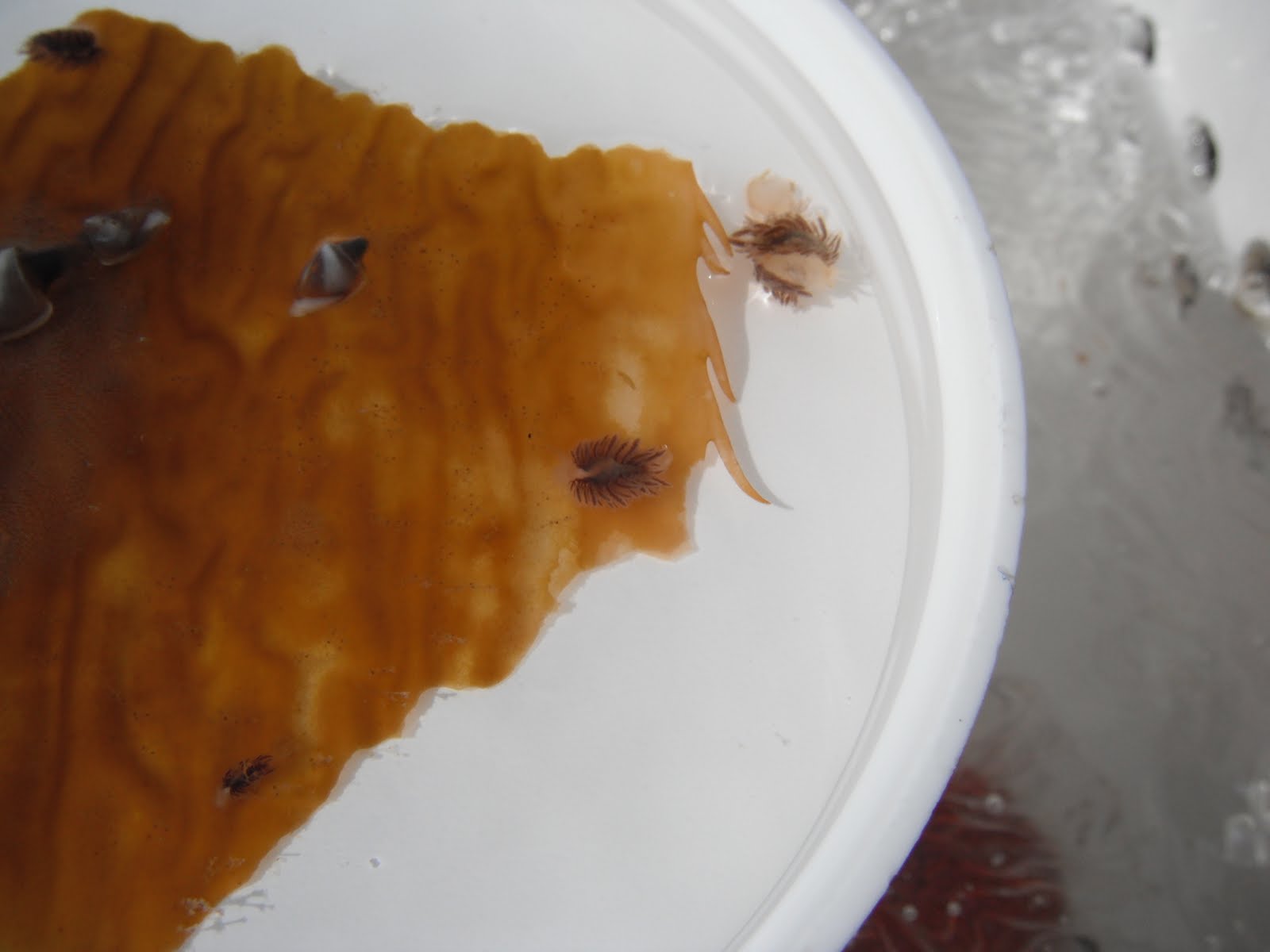
We also found a couple of different types of nudibranchs. The ones pictured below are pelagic nudibranchs and are commonly found on drift wood or drift kelp. Their color depends on what they eat, with brownish individuals dining one pelagic barnacles (also in the photo) and purplish ones dining on the by the wind sailor.

We did not have any luck chumming for blue sharks this year, but we were very lucky to see this crazy critter come by our boat. Yes my favorite fish ever, the mola (or ocean sunfish) swam near our boat. Judging from the size of the fin sticking out of the water, this beauty was huge! It made my trip!

We also were lucky enough to see a variety of marine mammals. These pictured below were Risso's dolphins, the largest dolphin in our area. We also saw bottle-nose and pacific white-sided dolphins.