Friday, November 28, 2008

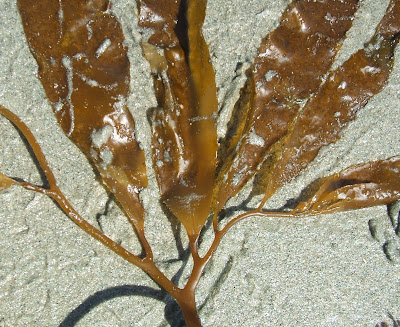
Life Photo Meme: Edible


Kingdom: Protista

Phylum: Phaeophyta

Class: Phaeophyceae

Order: Laminariales

Family: Lessoniaceae

Here we have some giant kelp, Macrocystis pyrifera. While not very tasty by itself (to my mind), brown alga such as the giant kelp contain algin. Algin is often used as a thickening agent in many foods such as puddings, ice cream, icing, candies, as well as some beauty products. If you have a thick and creamy food item, check the ingredients and chances are algin or carrageenan (from red algae) is present. While algin may help add to our waistline by being in such yummy foods, a second compound, fucoxanthin may promote weight loss [1, 2].

Sunday, November 23, 2008

Cloning mammoths?!

There's a really interesting article in November's issue of Nature. The author Henry Nicholls answers the question what would it take to clone a mammoth. This is more of an intellectual exercise than an actual doable process at the moment, but only because they don't have the entire genome of the mammoth sequenced yet.

I was very impressed with the detail and clarity of the article, it brought up questions that I never considered. When making a mammoth, figuring out the genome is a relatively easy task. It's fairly easy to read the genes, but which genes go on which chromosomes? How do you then turn that huge library of letters into a set number of chromosomes, when you have no idea what that number is? And what about mitochondria? Those organelles are not built by instructions contained in the nucleus, but are transferred from mother to offspring (in rare cases, the fathers contribute some too). Nicholls does a wonderful job of laying out the problems and suggesting solutions based on research techniques that are currently being used for other (but similar) purposes.

So if you want to know what would be involved in building a mammoth, or you are just interested in learning about some cutting-edge research in cellular biology, check out this article.

Uber-cute!

I love walking into my workplace and seeing stuff like this. This baby pacific seahorse is just three days old and about a centimeter long. The male gave birth to a batch of babies after a 9 day gestation period. Normally, they can hold 2-3,000 eggs in their pouch, but this particular daddy gave birth to only 75. That could be because the female dropped the eggs when she was transferring them to the male, or because she just did not make that many eggs. I am looking forward to seeing these little cuties grow up.

BTW, those dots you see around the seahorse are rotifers, which are the current food source for our babies (and only ~0.5mm long!).

Saturday, November 22, 2008

Photohunter: Reflection of my inner geekyness


This is a picture of a collection of artifacts I have in my house. The collection is often a surprise to most visitors, but give who we generally hang out with, it ends up being a fascinating conversation piece. Not only does our collection offer a glimpse at our inner geekyness to visitors, but they are often used as educational tools for the various classes and fairs that we teach. Most of these items were gotten from the various institutions that me and my husband have worked at or volunteered for over the years. Often, when departments have to move their collections, things get stuck in a cardboard box in the back halls with a sign saying "free, take me home!".

Some of my favorite pieces are:

  • A 60 million year old sperm whale fossil tooth bought from the Bone Room (a super awesome place), the elongate, black fossil in the front center right.
  • A paper nautilus 'shell', in the open box in front of the true nautilus shell.
  • A copy of an archaeopteryx skull, in the clear black bottomed box in the center.
  • A fossil of an open brachiopod, showing the fossilized internal structures (mainly the brachidium, which supports the lophophore)

It's a good thing my spouse and I both like biology!

Life Photo Meme: Unloved


Kingdom: Animalia
Phylum: Chordata
Class: Reptilia
Order: Squamata
Family: Viperidea

This rattlesnake is definitely an unloved animal. Most live in fear of encountering it due to its poisonous nature and rapid strike abilities. It has the ability to strike without pulling its body back first, and can reach 1/3 to 1/2 their body length. The rattle on the tail is added to every time the snake sheds its skin. However, there is one species of rattlesnake which does not have a rattle, the tree-climbing Santa Catalina Island rattlesnake. Since this rattlesnake sneaks up and eats birds, it lost its rattle.

Rattlesnakes are ovoviviparous, retaining eggs within their body and giving birth to live young after 90 days. They are also the newest snake group, with an interesting heat sensitive organ located on the sides of their heads. According to the San Diego zoo, when rattlers hibernate for the winter, they use the same den that they were born in. It has been reported that some dens have been used for 100 years [1].