Showing posts with label chordates. Show all posts

Tuesday, May 7, 2013

It must be spring...

So in finding a new spot for my staghorn fern, I inadvertently made a perfect nesting site for some carolina wrens, who moved in a mere two weeks afterwards.


A week so later, I peeked in and saw some eggs...


Today I noticed a lot of activity going on at the nest, with the birds bringing lots of food in.


Peeking in the nest I saw why... The eggs had hatched.


While I watched the pair brought 3 bugs in under 15 minutes.


Carolina wrens like to nest in odd places like mailboxes and broken taillights, and will nest a couple of times a season.  The chicks will fledge in 12-14 days.

Friday, August 12, 2011

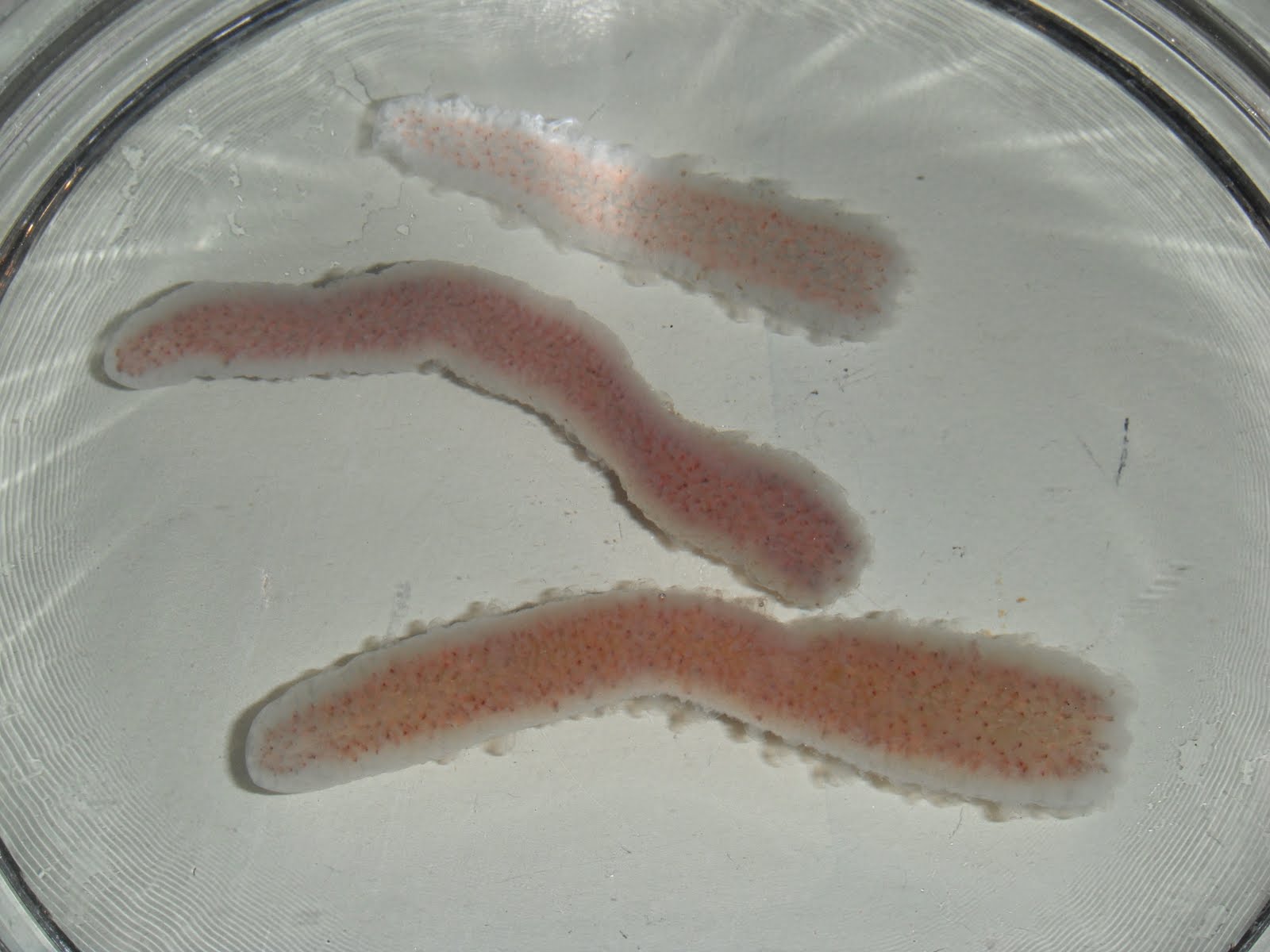
Pyrosomes


So I ran across these crazy animals called pyrosomes a while back and I have been completely fascinated by them. When I was first presented with them, I could not figure out what they were! It turns out that they are a type of tunicate... and indeed looking at them under a microscope does help point that out.


Here you can see an individual of the tunicate colony, making a u shape, and surrounded by a clear tunic. The left side of the U is most likely the endostyle, a structure which gives support. On the right side of the U, the thicker side, is the pharynx, which they use to filter their food. Below that, the thick, pinkish structure is most likely the gut.

Each of those pyrosome colonies were made up of hundreds of these individual zooids, each of which captured its own food by filtering water through its pharynx. However unlike regular tunicate colonies, where the filtered water comes out somewhere along the surface of the colony, in pyrosomes (which are shaped like a cone with the smaller end closed off) the filtered water is shuttled to the inside and then comes out the large end. This allows them to swim!

It's hard to imagine these very dense, hard colonies swimming, but that's just what they do. Additionally, their name (pyrosomes = fire body) comes from one other unique feature that they possess. At the tip of each of the zooids they have a light producing organ, which allows the colony to light up like a christmas tree. I would love to see one drifting along, shining gently in the dark sea...

Monday, June 27, 2011

Grunion Development: Day 9


Not much seems to have changed from day 8 to day 9. The grunion is still the same size, and has not gained any new pigmentation. The yolk has decreased a bit, but at this point no major developmental; changes are visible. However, on day 9 they are much easier to hatch!


You can still see the remnants of the yolk in the young fish's stomach.

Sunday, June 26, 2011

Grunion Development: Day 8


The eyes are fully pigment, and the body as well. The body has grown to such a length that it wraps around the inside of the egg a little over 2 times. The oil droplets have been completely depleted, and there is a little yolk left. What you can't see is that the embryo is very active, with eye and body twitches being quite common.

Friday, June 24, 2011

Grunion Development: Day 6


The embryo has grown, with the tail wrapping all the way around the egg and back around the head. The eyes have a lot of pigment and the body is starting to get a little pigment. The oil droplets are almost all used up and the yolk has a lot of blood vessels connecting it to the embryo.

Wednesday, June 22, 2011

Grunion Development: Day 4


The embryos are noticeably larger, and structures are becoming readily apparent. You can see the nerve cord running down the center of the embryo. gill arches forming behind the eye, and the eye itself has an indented pupil.

What you can't tell from the picture is that the heart is also nociable and pumping, and there are musculature visible along the length of the tail.

Tuesday, June 21, 2011

Grunion Development: Day 3


Now you can clearly see many features of the developing embryo. It has also grown large enough to wrap around the back of the egg, with the tail just peeking out on the left hand side. The oil droplets are being used up and condensed into one large drop right in the center.

Monday, June 20, 2011

Grunion Development: Day 2


Now it's approximately 37 hours after fertilization. You can still see the oil droplets off to the left, but the embryo has under gone some big changes. Instead of being a cap of cells it now has a definite form, with the head and developing eyes in the center, and the rest of the body trailing off to the top right.

Sunday, June 19, 2011

Grunion Development: Day 1


I thought I'd take some pictures of grunion eggs as they develop, just because I could. Here is day 1, approximately 13 hours after fertilization. You can see the dark orange oil droplets in the center, and a pale yellow cap of cells off to the left. That is the developing embryo.

Wednesday, September 22, 2010

Anatomy of an electric ray

I love my job. Sometimes I just get to participate in (or watch) cool stuff. As was the case a week ago, when I learned that we were going to be dissecting an electric ray.

This electric ray had been brought in by a fisherman, who didn't want to eat it or let it go to waste. So we decided to hold a public dissection, so that we could learn more about it. We also preserved some of the pieces for our collection, to be used for later research or teaching.


Electric rays are slow-moving rays that live off of the pacific cost, in cool waters. They don't have a stinger, but do have a specialized organ that produces electricity, which they use to capture food and defend themselves.

In this picture you can see the two-chambered heart, center, at the right most edge of the cut. Below that (center) is the stomach. To either side of the stomach are two very large livers. Like all sharks and rays, the electric ray lacks a swim bladder and depends on the oil reserves in the liver to help maintain buoyancy. The large green ball near the upper liver lobe is the gall bladder.


This is a nice close-up of the electric producing organ. Basically, it is little more than coin shaped muscle stacks. Since muscles produce electricity, the arrangement of muscle tissue in this configuration helps optimize the amount of electricity produced in the area. By having an organ on either side of the body, the electric ray can stun prey trapped between the two sides of their fins.

Thursday, June 25, 2009

Life Photo Meme: Soiled


Kingdom: Animalia

Phylum: Chordata


Class: Myxini

Order: Myxiniformes

Family: Myxinidae

This is a close-up picture of a hagfish's slime. The hagfish can produce vasts amounts of slime, enough to fill a bucket that they happen to be captured in. This slime consists of fibrous protein threads, mucus, and seawater. You can see the threads in this picture, if you look carefully.

Recent research suggests that the bulk of the mucus is actually seawater that is trapped in the mucus-coated threads [1]. This makes a certain amount of sense, given that the mucus expands rapidly when in contact with water (much like a sponge). It may also explain how these hagfish can produce such vast quantities of slime...basically, they are just puffing up a little bit of slime with water.

What hagfish use this slime for is still under debate. Most seem to be leaning towards the idea that the slime can clog the gills of potential predators.

Thursday, June 11, 2009

Life Photo Meme: Travel


Kingdom: Animalia

Phylum: Chordata


Subphylum: Vertebrata

Class: Aves

Order: Anseriformes

Family: Anatidae

These Canadian geese represent travel in so many different ways. I took a picture of these geese on a recent trip to New Mexico. Of course the geese themselves are highly migratory; flying from northern Canada to the southern US.

There are 11 subspecies of Canadian goose found in the northern hemisphere, and their body size decreases with increasing latitude. This split in sizes may be due to the fact that Canadian geese practice assortative mating. In this case, the birds choose their mates based on size; they prefer to mate with a goose that is the same size as them.

In my childhood, seeing geese flying south was a regular feature of the fall season. It seems very odd to me to see these birds flying about in the winter, now that I live in the southern areas.

Thursday, June 4, 2009

Life Photo Meme: Honor an invert


Kingdom: Animalia

Phylum: Chordata


Subphylum: Urochordata

Class: Thaliacea

Order: Salpida

This is a pretty neat animal, which just barely qualifies as an invertebrate. This is a salp, although I am not exactly sure which one. Salps are some of our closest relatives, as they possess several of the same characteristics, including a notocord. They are in the same phylum as the tunicates, or sea squirts, but unlike the tunicates, salps spend their entire life in the plankton.

The thin white band you see running along the bottom of the salp is the gills, which they used to filter feed with. The pinkish-yellow lump on the bottom right hand side is where most of the organs are (intestines and such). On the left hand side are two small orange ovals. These are another creature (amphipods) that are living inside of this salp. They can capture food from the salp's filter feeding current.

Salps can be found as solitary individuals or found in long chains of individuals, and can reproduce sexually and asexually. Their life cycle is rather complex because of this. As solitary individuals, salps reproduce asexually to form a chain. This chain can reproduce sexually with other salp chains. The sexual and asexual forms of the same salp species can look slightly different.