Showing posts with label insect. Show all posts

Sunday, December 4, 2011

Mysterys and metamorphosis

I am being more and more drawn to the mysterious bug world that seems to be invading my life. Now I can experience the thrill of invertebrates on land! When I noticed this strange bug the other day I was completely taken aback. I could not figure out even what kind of bug this could possibly be. I suspected that it might be something larval, as I saw a few shed exoskeletons which might have been the same thing. But still, what was it? Not a caterpillar that was for sure. It had six legs, so it must be an insect... not a spider. But no wings? Hum...

To top it off, I noticed yet another strange bug near by. It looked like it might have been a beetle, but there was no hardened wing coverings and the abdomen was just to darn long. And what was with those crazy 'feet' at the end of the abdomen?

Puzzled I took some photos and went on my way, thinking I would never know for sure. I tried some searches for my mystery bug number one, and thought it might be some kind of mealy bug, but I was not totally convinced.

So a few days pass, and I go out to my plants where mystery bug number two is hanging out and low and behold I see a new bug, this one fairly recognizable:

Well, well a ladybug hanging out where mystery bug number two is... Maybe mystery bug number two is a larval form of the lady bug. They are the same color, and you can see the spots starting to form. So I do a little searching and find out that this lady bug is Harmonia axyridis, an asian ladybug. Lucky for me, I also get to solve the identity of mystery bug number two AND number one.

As I suspected, mystery bug number two is a pupal form; of the asian ladybug. Number one is the larva of that same individual. What I took for 'feet' was actually the discarded molt of the larva at the end of the pupa. Metamorphosis is so cool... but I can imagine that it drove early entomologists up the wall trying to identify things, much like it drives us plankton-lovers up a wall!

Wednesday, June 17, 2009

Bug Fair


A couple of weeks ago was the annual bug fair at our local museum. This was a pretty big deal as vendors from all around came to sell their bugs and bug-related gear. At the fair you could find dead bugs for your collection, live bugs for rearing or pets, bug catching and displaying gear, as well as t-shirts, hats, and other related things.

There was also a bug chef on hand, and live bug handling demonstrations through out the two day period. My favorite talk was give by a gentleman who did origami for a living. He had some amazing pieces, which looked just like bugs!


He was a physicist by training, so tended to approach origami from a mathematical point of view. He created a program which could tell you how to fold the paper to get any shape you wanted. He also pointed out the scientific uses of origami, such as airbag storage, a new stent which unfolds in your vein or artery to keep it open, and how telescopes in space use origami to fold into different configurations... Way cool!

Thursday, May 28, 2009

Bugs, bugs, and more bugs

Two weeks ago was the awesome bug fair at the Natural History Museum of LA, which is always a great event to attend. I was looking forward to it this year because we were planning on getting some companions for our gray death-feigning beetle, Stumpy. In preparation for this, we upgraded her tank to a 10 gallon terrarium and got her fresh plants.


She started laying eggs in the new enclosure, which I took as a sign of approval. However, I have suspected that the eggs that she has been laying may not be fertile, so we were really hoping to get a male for her. When Bug Fair rolled around we picked up 3 more beetles. We think we did get a male, as the smallest beetle likes to clamp on top of the identified females (ran up to stumpy first thing) and they always try run away.

One of the other beetles is most likely another female, as she exhibited egg-laying behaviour fairly soon after being placed in the tank. Hopefully, we'll have little ones in a few months, although I am worried about getting this larger tank up to the temperature that I suspect may be necessary for larval development (over 100 degrees F).

Here you see the ovipositor...

and lay those eggs, lady!

Life Photo Meme: Woven


Kingdom: Animalia

Phylum: Arthropoda


Class: Insecta

Order: Lepidoptera

Family: Bombycidae

These are silkworm (Bombyx mori) cocoons. While I always knew that silk was made from silkworms, and that the cocoons were boiled and unraveled to make a single strand of silk, I did not know that the cocoon could be unraveled to 1 Km (~ 1,100 yards).

Silkworms eat the leaves of mulberry trees and are native to northern china. They are considered domesticated, and have been raised by humans for over 5,000 years. They are considered unable to survive in the wild at this point and depend on human intervention to complete their breeding. (Supposedly, because they have lost the ability to fly) The silkworm pupa is also considered a delicacy and is eaten after the cocoon itself has been boiled to soften the silk strands.

Thursday, May 14, 2009

Life Photo Meme: Metallic


Kingdom: Animalia

Phylum: Arthropoda

Class: Insecta

Order: Coleoptera

This is a box of beetles, which are one of the most numerous insect groups on the face of the planet. This combined with the fact that insects are the most numerous animal, means that this planet really belongs to the beetles. While the bright colors are often used as a warning signal that the beetle tastes bad or is poisonous, it can also be an attractive signal to lady beetles.

Jewelery and other fashion accessories have been made from the beetles' shiny metallic overwings. On the science side, beetles are used to create carmine particles. These particles have helped researchers understand water flow and feeding rates for many aquatic organisms, and are also used as a food coloring (red) for many foods.

As a fun side note to this insect-filled week, if you are in the LA area check out the Bug Fair at the Natural History Museum of LA this weekend. It is one of the largest and most amazing insect fairs around!

Thursday, May 7, 2009

Life Photo Meme: Honor an Invert


Kingdom: Animalia

Phylum: Arthropoda

Class: Insecta

Order: Hemiptera

Family: Belostomatidae

This crazy looking bug is a giant water bug, Abedus herberti. They are found in pools of freshwater in the mid-west to southwestern region of the US. This is a male water bug, as females lay eggs on the backs of the male carapace. Matings are cyclical, where a female will only be allowed to lay a few eggs on a male's back before having to mate with him again. This will ensure that the males aren't brooding eggs fertilized by another male. This is particularly effective as genetic markers show that the last male's sperm has precedence in fertilization over any stored sperm [1].

The males take care of the eggs until they hatch. This includes spending more time on land, to keep the eggs from getting fungus. I would be interested in knowing what traits females are selecting for when they choose their mates.

Saturday, November 1, 2008

Life Photo Meme: Scary but cool spider


Kingdom: Animalia

Phylum: Arthropoda

Class: Arachnida

Order: Araneae

Family: Tetragnathidae

Spiders are definitely on many people's scary list, especially when they are as large as your hand. This is a golden orb weaver, most likely Nephila clavipes. The Nephila genus is rather interesting. Males tend to be much smaller than females, 1/10 the size of females, and live on the female's web eating their food. Males will mate with the female while she is busy, general while she is eating.

Of course, what the golden orb weavers are most famous for is their webs.

Their webs are a beautiful golden color, very large (1 meter or 3 feet in width) and very strong. Their webs are strong enough to catch a bird (not that they want to catch birds), and last for several years. There has been research on the properties of all spider silk, and some very innovative uses for the golden orb weaver's silk in particular. The silk of golden web spiders has been used to culture nerves cells, and may be useful as a 'nerve graft' as nerve cells adhere to it, it does not cause a major immune response, and is resistant to decay by bacterial or fungal agents [1].

Friday, October 3, 2008

Life photo meme: Mantis diversity


Desert mantis photographed by Los_Cat

Kingdom: Animalia

Phylum: Arthropoda

Class: Insecta

Order: Dictyoptera

Family: Mantidae

I thought I'd put up some pictures of wild mantises. There are some 2,000 species of mantis world wide. As they are often ambush predators, they come in a wide variety of shapes, sizes, and colors to match their preferred hunting grounds. Some of the mantises which hunt on flowers are truly amazing looking. These two mantises were photographed in different habitats, and you can definitely see the differences.

Mantises have pretty amazing eyesight. Their compound eyes have specialized regions with overlapping fields of view that allows them to track movement very well [1]. They have amazing flexibility in their necks, allowing them to rotate their heads. This head movement can also help them estimate distance to their prey [2]. Some species have an 'ear' on their thorax which allows them to detect bat calls [3].

Wednesday, September 17, 2008

Return of Stumpy

Stumpy has returned from her journey to the local museum. The bug expert did get to see her egg laying behaviour, and still is baffled as to why she is doing it. He thinks it may be the plants. He also thinks that the mealworms won't survive to pupate, and indeed when I got her back there were no mealworms left in her tank (see here for pictures).

She is still laying eggs however, so I remain somewhat hopeful. I've got a second small tank set up with a 1: 3 mixture of oats and sand and am transferring half of her eggs into that tank. Other mealworms (often used for feeding) are raised on oats, so I am hoping that a high concentration of possible food will help the process.

Iron clad Egg

I am also keeping a journal, recording the day and place of any new eggs I discover, when I feed her and what, when I place her in the sun, and the temperature of the tank. I'll also be recording when I spot the 1st mealworms, so I can see how long it takes for the eggs to hatch.

I still believe that temperature has something to do with it. Today I put her tank in the sun, and the thermometer read 125 degrees F! I am not sure how accurate this is, as I used my oven thermometer, and the metal may have heated more than the air temperature actually was, but I plan on getting a real thermometer tomorrow, so we'll see. I would not be surprised if it does get over 100 degrees F.

Thursday, September 4, 2008

Lifephoto Meme: Hooray for stumpy!


Kingdom: Animalia

Phylum: Arthropoda

Class: Insecta

Order: Coleoptera

Family: Tenebrionidae

I've already posted a picture of Stumpy, my death-feigning beetle, But I had to post another one to celebrate the cool thing I discovered yesterday. The death-feigning beetle (Cryptoglossa verrucosa) is also called the iron clad beetle for its armor-like appearance. They are found in the deserts of the south west (California, Arizona, and the like), and are able to get all of their water from their food.

I obtained Stumpy and a friend from a bug fair last may, and named her Stumpy because she is missing the tarsus (or tip) of her right front leg. Her companion died about a week and a half after bringing them home. Since then, I've been half-hoping that some of the interesting behaviors that I witnessed when the companion was around were mating behaviors, but did not expect too much since months had passed.

Low and behold, when I checked her tank the other day I found this....

A cute little beetle larva! She had been burying her abdomen in the sand a few weeks earlier (which prompted me to start calling her a girl), and now I have confirmation of several of my hypothesis. She is a girl, the burying the abdomen in the sand was probably 'ovipositing' behaviour and she had stored sperm either from her companion or from when I got her! Cool! It's a bit nerve-wracking since the people I know who care for these guys have never had young before, so I hope some of them survive!

Sunday, August 24, 2008

Playing dead


Just read a neat paper on the heritability of death feigning and how it may be selected for in the wild by Miyatake et al. (2004). Death feigning is when a creature pretends to be dead, either by falling off a twig and curling up its legs, or by freezing, presumably to escape predation. The gray death-feigning beetle pictured above can feign death for up to thirty minutes (according to the beetle dealer). What Miyatake and the others wanted to know was, is this death-feigning ability heritable, and does it actually help them escape predation?

So they took 200 red flour beetles and recorded how long they played dead for after touching them with a stick. The 10 males and 10 females who feigned death the longest were used to start a long line, and the 10 males and 10 females who feigned death the shortest were used to start a short line. They then repeated this procedure for ten generations, allowing only the 20 longest feigners and 20 shortest feigners to reproduce each generation.

After ten generations, they found that the long line feigned death for a longer period of time than the short line did. The long line feigned death for over a minute and a half, while the short line only feigned death for about 5 seconds. They also found a difference in the numbers of individuals who actually feigned death. What they saw was 86% of the long-line individuals feigned death, while only 7% of the short-line individuals feigned death.

So now they know that death feigning is heritable and can be selected for or against in nature, but does it actually work to help save them from predators? Will it actually be selected in nature? To find this out, they introduced a predator and recorded survivorship and behaviors of short-line and long-line individuals. What they found was that the jumper spider used as a predator would lose interest in the beetle if it feigned death. So most of the long-line individuals survived (64%), and most of the short-line beetles were eaten (73%).

So if the beetles have predators in an area that act like the jumper spider, you could expect that the beetles in those areas would have long death-feigning times, but in other areas without such predators, you may expect shorter feigning times. Now all you have to do is go out and test that!

Saturday, July 19, 2008

Photo Hunter: What is it?


This was a tough one to pick, as I have TONS of pictures of creatures that most people don't know what they are. I also have pictures of larval forms of a variety of creatures. I decided to go with an animal that people can recognize, but I like this photo for the shock value. Who would pay $15,000 dollars for a butterfly? Well, the reason why this butterfly costs so much is: it's a gynandromorph. That's not the name of the butterfly species, but rather the condition of having both male and female characteristics. The males of this butterfly species have a green back, yellow abdomen, and some green on their wings. The females have brown on their wings.

Thursday, July 10, 2008

Life photo: garden


Kingdom: Animalia

Phlyum: Arthropoda

Class: Insecta (Hexapoda)

Order: Lepidoptera

Family: Saturniidae (silk moths)

This is a caterpillar of Samia cynthia, the cynthia moth. It is originally from Asia, but was introduced to the eastern US, when they wanted to start silk farms. It is only one of the moths used to produce silk, and not considered as 'domesticated' as some of the other members of the saturniidae family. I am particularly proud of this picture, because I raised this cynthia from eggs deposited in my classroom (the adults had been bought for the students to look at). It was a super fun experience, as my summer class got to see them grow from little black fuzzy caterpillars to these great honkers about the size of my middle finger. I got to spend a lot of time taking leaves off of the various trees on campus and from my 'garden' to see what they would eat. (When we got the adult cocoons they were labeled with the wrong species name, so I could not just look up their diet on the web) They spun a cocoon during class in the fall, and many of my students would periodically check up on them during class (not bad for a non-majors course!).

Wednesday, November 21, 2007

Animalpedia: Harlequin bugs


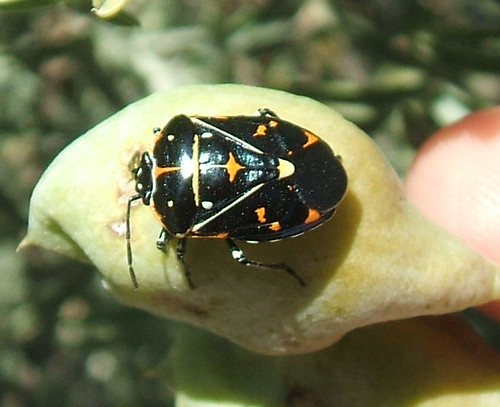
These are Harlequin bugs, or Harlequin cabbage beetles (Murgantia histrionica). They live by sucking the juices out of cabbages and other cabbage family members. Most of the time they are considered a pest by farmers. They are part of the stinkbug family, although they also play dead when disturbed.

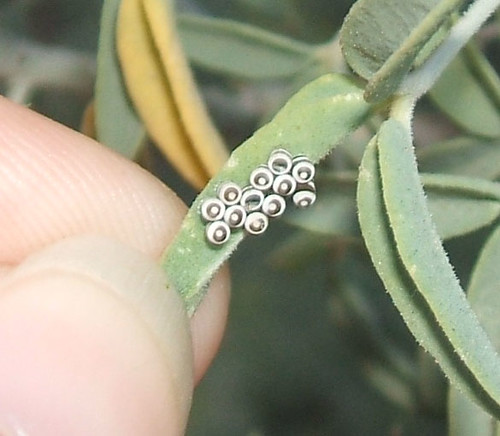
The females lay up to 12 eggs in a double line on the leaves…


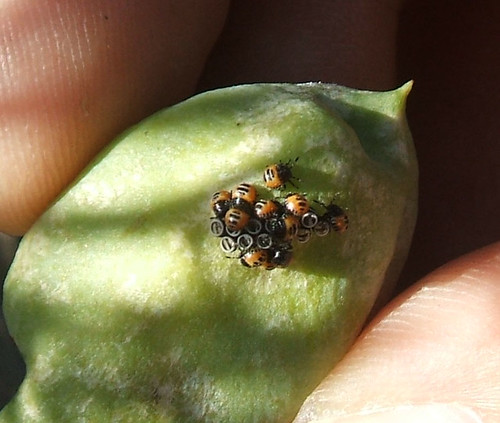
After hatching, the young (nymphs) cannot fly. They will go through 5 successive molts before they get the color patterns and the wings of an adult. That takes approximately 42-47 days.

They are very dependant on temperature conditions for their growth and development.In northern areas, they only have one clutch per year. In southern areas they can have three clutches. When mating the male and female stand with their abdomens touching, for the transfer of sperm.
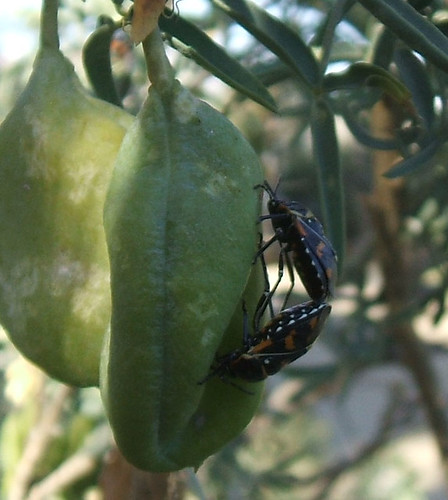
These bug pictures were all taken on one Bladderpod bush, a native bush to California. Some harlequin bugs will spend their entire lives on a single bush.