I thought I'd take some pictures of grunion eggs as they develop, just because I could. Here is day 1, approximately 13 hours after fertilization. You can see the dark orange oil droplets in the center, and a pale yellow cap of cells off to the left. That is the developing embryo.
So I went on a trip to sample some of the sea life found around Catalina Island this past weekend. In the deeper parts we found some hag fish, which produce copious amounts of slime with the slightest provocation. The slime has microfibers in it and makes it particularly strong.
We were also lucky enough to get a deep sea octopus. This one might be a big-eye octopus, as it lacks the spots of a two-spot octo, and was caught in very deep water.
This trip was filled with all sorts of cool mollusks, like this very large black sea hare. It was probably around 13 pounds. We caught about three of these beauties. The black sea hare is the largest gastropod in the world! Luckily for me, it does not ink.
We also got a lovely navanax. The navanax is a predatory snail that follows the slime trails of other snails then swallows them whole. After digesting them, it will spit out the cleaned out shell.
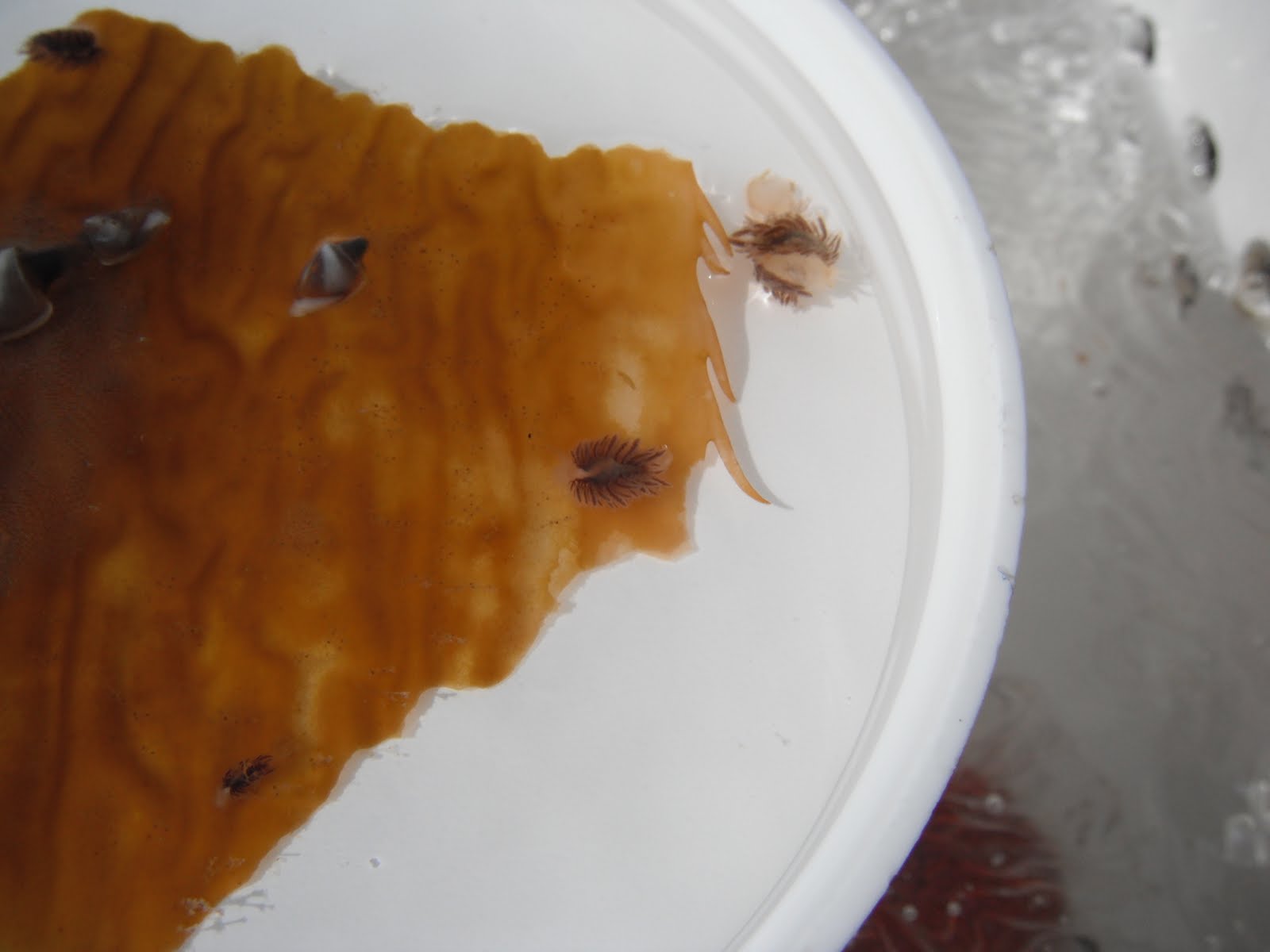
We also found a couple of different types of nudibranchs. The ones pictured below are pelagic nudibranchs and are commonly found on drift wood or drift kelp. Their color depends on what they eat, with brownish individuals dining one pelagic barnacles (also in the photo) and purplish ones dining on the by the wind sailor.
We did not have any luck chumming for blue sharks this year, but we were very lucky to see this crazy critter come by our boat. Yes my favorite fish ever, the mola (or ocean sunfish) swam near our boat. Judging from the size of the fin sticking out of the water, this beauty was huge! It made my trip!
We also were lucky enough to see a variety of marine mammals. These pictured below were Risso's dolphins, the largest dolphin in our area. We also saw bottle-nose and pacific white-sided dolphins.
So we went on a trip to the Mohave natural preserve, with the idea that we were going to see Mitchell caverns, the only limestone cavern in the CA park system. Based on some of the pictures it looked like a mini Carlsbad cavern, so I was very excited. Of course, the first thing to greet us after the four hour drive was this...
The caverns had been closed since December of last year for 'maintenance', supposedly to re-open in October... So we decided to drive around and see what else there was to offer, hoping to see some neat fossils that we had heard might be around the area.
There was a nice stand of Joshua trees on our drive...
and some other nice pockets of desert flora...
After a confusing talk with the rangers at Kelso station, we (and the rangers) finally learned where the fossil sponges were located, from their on-call geologist. While not much to look at, it was still something that I had never seen.
There was also some evidence of modern life too...
And of course, the Kelso dunes themselves...
All and all an okay trip. I was definitely disappointed about the caves, and would have planned a trip to Joshua Tree National Park instead if I had known ahead of time. What was really nice about the trip was the people. The rangers were very willing to chat, and helps us find places to see, or places that were at least open...
We got a new addition last week, a Carinaria japonica an unusual animal commonly called a sea elephant, after its long snout-like proboscis. It is generally around 13 cm (5 in) but can get to 50 cm (20 in) long. This one is about 30 cm (12 in). This animal is a type of snail, called a heteropod, that is modified to spend its entire life swimming in the water column.
Its shell is very reduced, to decrease the weight on the animal, and located on the bottom of the creature. Because of the shell's weight, small that it is, the animal spends its life swimming 'upside down'. The flap that it uses to swim with is a modified foot, and it has a large radula at the end of its proboscis for capturing prey.
It has very well developed eyes for a snail, complete with spherical lenses and ciliated retinas. The retinas themselves are interesting, because they are a thin strip, rather that a large patch. Because of that its vision field is only a few degrees high, and 80 to 180 degrees long [1]. Some species solve that problem by constantly sweeping their eyes up and down.
They eat other things in the plankton, preferring things like arrow worms, salps, copepods, and krill [2]. The prey is ingested whole, and digestion generally takes place without any mastication. There really is not much known on how they capture their prey, and I'd like to make a few comments based on observations made while feeding this little guy.
I have been feeding him by hand, which is certainly not natural, but I have noticed that when I drop food or put food near him, he cannot capture it without some sort of pressure behind it. The jaws of the radula seem to push out, then open, clamp the food then drag it back in. If there is no pressure behind the food, the radula just pushes it away. He generally solves the pressure problem by maneuvering his proboscis so that the food is trapped between it and the wall of the tank.
Obviously, that trick would not work in the wild, but I have noticed a second trick which would work in the wild. With floating food, he sometimes curls in to a circle and traps it between his proboscis and his large broad tail. This may be a behavior which helps them capture food in the wild... we won't know for certain until someone seriously takes a look at that.
In the meantime, I will continue to observe and marvel at my new companion...
Saturday, February 12, 2011
You know how I love me some developing squid... Here is some before and after shots of the common market squid.
You can see that baby still in the capsule with the yolk coming out from the tentacles. When the squid is ready to hatch, the capsule and the chorion (which surrounds the embryo) are greatly thinned. However, they still present a considerable barrier. Squids have a hatching gland, called the organ of Hoyle, which produces an enzyme that dissolves the chorion and the capsule wall.
Here's a nice quick shot of a post-hatch baby. You can see some of the chromatophores, pigment-containing cells, as black dots on their body.
To round off this post, I thought I'd close with a video of those chromatophores in action!
I am a student of Marine Biology, just finished up my masters and no longer contemplating continuing on... I AM continuing on! Most of my clothes are salt stained and my personal philosophy is ‘Spineless is splendid’.