Friday, October 17, 2008

Life photo meme: Bat star


Kingdom: Animalia

Phylum: Echinodermata

Class: Asteroidea

Order: Spinulosida

Family: Asterinidae

It's hard for me to think of anything more voracious than a sea star. I like to refer to them as the walking stomachs of the sea. If you open one up, you will see the digestive gland and little else. This particular sea star is a bat star (Asterina miniata), and it eats plants (like surf grass), animals (anything it can catch, dead or alive), and even the thinnest biofilms (bacterial, protozoan). It basically everts its stomach on anything organic and digests it. The thin tissue in the picture is the bat star's stomach.

Bat stars will fight each other whenever they come into contact. A battle consists of one star trying to put its arm on another. So both stars will rear an arm up and very slowly try to lay it on top, like a slow-motion thumb war (you remember that game, right?). It's rather amusing to watch, if you have the time.

Saturday, October 11, 2008

Photohunter: Lazy


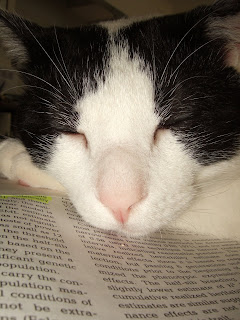
This photohunter I thought I'd honor my cat, Rob Anybody McFeegle, or Robbie for short. He's not any lazier than any other cat in general, but when he sleeps he is just too funny.


Like most cats, he spends a good amount of time sleeping on things that I need... like my hand while I am typing, or the keyboard, or various papers I am referencing.


Unlike my other cats, he does not spend a lot of time curled up in a corner. He likes to sleep sprawled out in the middle of the floor. His favorite position is on his back with his paws spread out.

Of course it's a good day when he can combine sprawling on the floor and laying on stuff I am working on.

Friday, October 10, 2008

Life photo meme: Swell shark


Kingdom: Animalia

Phylum: Chordata

Class: Chondrichthyes

Order: Carcharhiniformes

Family: Scyliorhinidea

This is a swell shark, or Cephaloscyllium ventriosum. They are common inhabitants of the kelp forests; found during daylight hours laying about on the floor. Swell sharks have a neat trick of inflating by gulping down water or air. They can use this technique to wedge themselves into rocks, making it impossible for predators to get them out. There is a really awesome website describing all of the research done on them here. I am going to summarize some of it, but be sure to check it out for the full detail.

Swell sharks lay eggs, which can take up to a year to hatch. They are poor swimmers and nocturnal, but don't use light cues to initiate activity. Instead they relay on internal cues, general going for a 12 hours of sleep, 12 hours of activity. When they hunt, they use two different tactics: it waits until the fish is close to its head, than sucks it into its mouth with a "gulp", or it slowly opens its mouth and waits till a fish drifts in.

Saturday, October 4, 2008

Photohunter: Funny, but sad...


Signs like this always make me laugh and then shake my head. It's always sad that signs like this are needed. Sometimes people just need to use a little courtesy and common sense. What's really sad is that I know that even with the sign, there is a very good chance that stuff is still being tossed at the alligator.

Friday, October 3, 2008

Life photo meme: Mantis diversity


Desert mantis photographed by Los_Cat

Kingdom: Animalia

Phylum: Arthropoda

Class: Insecta

Order: Dictyoptera

Family: Mantidae

I thought I'd put up some pictures of wild mantises. There are some 2,000 species of mantis world wide. As they are often ambush predators, they come in a wide variety of shapes, sizes, and colors to match their preferred hunting grounds. Some of the mantises which hunt on flowers are truly amazing looking. These two mantises were photographed in different habitats, and you can definitely see the differences.

Mantises have pretty amazing eyesight. Their compound eyes have specialized regions with overlapping fields of view that allows them to track movement very well [1]. They have amazing flexibility in their necks, allowing them to rotate their heads. This head movement can also help them estimate distance to their prey [2]. Some species have an 'ear' on their thorax which allows them to detect bat calls [3].